
Mixed fleets: Mac, PC or both
Repair for a whole office fleet, whether it runs macOS, Windows or both
A real office has both, and the great majority are laptops. Here they are worked on at the same bench and under the same microscope, with a VAT invoice and the same written 12-month warranty as any other repair that leaves this workshop.
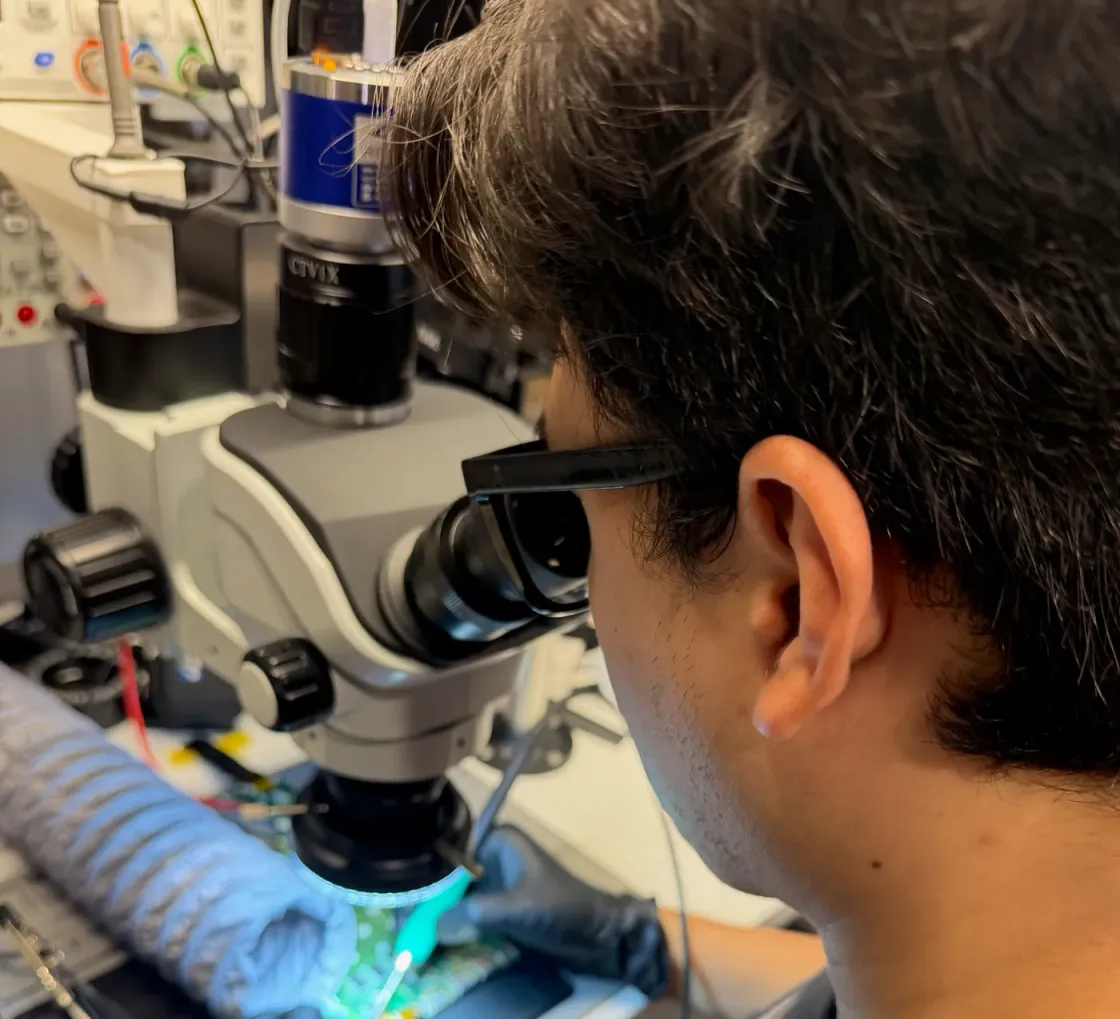
An office is never all one brand, and neither is this bench
We’re a repair service specialising in Apple hardware and we aren’t going to pretend otherwise: it’s what we do every day and where our accumulated judgement sits. But look at the workshop records rather than the sign above the door and the split is a different one. Of the 860 repairs logged between 2021 and 2026, slightly more than half weren’t Apple devices.
Which happens to be the split inside any office: design on Macs, admin on Windows laptops, and a couple of inherited machines nobody can account for any more. There’s no need to hand the fleet to two suppliers, because the workshop that can open a MacBook can open the rest.
- Three out of every four machines are laptops. From those same 860 records. That’s what an office runs on, and it’s also where the delicate work concentrates: charging ports soldered to the board, spilled liquid, hinges, and boards that have spent years travelling inside a rucksack.
- And the non-Apple side has familiar names. Lenovo, HP, Asus, Dell and Acer are the ones that come up most in that log. That’s history, not a catalogue: the part for an uncommon model sometimes simply doesn’t exist, and we’d rather look at it than promise it.
- 87.9 % went back out repaired. Of those 860 records, nearly nine in ten ended with the machine returned to its owner and working.
- Seven machines were declared beyond repair. Seven out of 860, under 1 %. When we say something can’t be fixed it isn’t the easy way out: it’s the exception, and it comes with an explanation of why.
Why an Apple workshop is the right choice for a Windows fleet
Component-level board repair on Apple hardware is, by a distance, the most demanding work this trade has. The boards are dense, many components measure under a millimetre, the schematics aren’t published, and every generation rewrites half of what the previous one taught you. That’s the ground we’ve been standing on since 2015.
And someone who probes power rails under a microscope every day finds nothing new inside a Lenovo or a Dell: it’s a step down, not a sideways leap. That’s why specialising doesn’t narrow what can be taken in, it widens it. How a board is actually worked, step by step and with the tools in view, is set out on microsoldering and logic boards; what that means on a machine that isn’t Apple, on PC, Windows laptop and Android repair.
Repairing the component instead of replacing the machine
For a company, the difference between swapping a board and repairing it isn’t a technical preference: it decides whether a failed laptop goes back to its user’s desk or turns into a purchase. And it decides what happens to whatever was inside it.
On Macs with the T2 chip and on every Mac with Apple silicon, storage is encrypted against that specific chip and, on laptops, soldered to that same board: separated from its device, the contents are inaccessible. On a Windows laptop the drive usually sits on a separate module and that scenario comes up far less often, but the order of work is the same.
- The machine comes back, it isn’t replaced. We repair a charging port, a power management chip or a dead rail on the original board rather than swapping the whole thing.
- The data doesn’t get left behind. When what’s urgent is what’s inside, say so as you hand the machine over and the job changes its goal: that’s data recovery.
- An honest diagnosis is a result too. If a machine is no longer worth repairing we’ll say so, even if it costs us the job. Better to hear it at the diagnosis than halfway through the repair.
- One point of contact for the whole fleet. Macs, PCs and Android devices come through the same door, get worked on at the same bench and are answered on the same channel.
What’s in writing
No published price list and no special terms invented for the occasion. What there is, is this, and it’s exactly what a private customer gets:
- A VAT invoice. The workshop is BestFixing S.L., tax ID B67958017: the repair is invoiced to the company, with VAT itemised and full tax details.
- A written 12-month warranty. The same one as on any other repair. It’s 6 months if the machine had already been repaired somewhere else, because we don’t control that history. The full terms are on the warranty page.
- A free initial diagnosis and a fixed quote. The price is known before anything is touched; if it isn’t approved, nothing is repaired and the machine goes back.
- A process you can follow. What happens at each stage and when you hear from us is set out on how it works.
Companies that already come here, without us having gone looking
It’s worth saying how we got here. There has never been an offer aimed at businesses: no fleet rate, no salesperson, no page like this one until today. And even so, the 2026 invoicing includes limited companies, cooperatives, professional practices and a professional association.
They arrived the same way a private customer arrives — with one specific fault, often after being told somewhere else that it couldn’t be fixed — and they stayed. More than 2,300 machines have crossed this bench since 2015.
And what this page doesn’t promise, said before anyone has to ask: there’s no collection from your office, no loan machines while a repair is under way, no contractual turnaround times and no volume discounts. None of that exists today, and announcing it to close a visit would mean starting the relationship already owing something. If it ever exists, it will be written here.
How to start
Write to us with what the machine is and what it’s doing: model, symptom, since when, and whether it took a knock, got wet or has already been to another workshop. With that we can advise you before anyone leaves the office. If it’s several machines, a list is enough to get started.
The workshop is at Carrer de Fontanella, 14, bajos · 08010 Barcelona, and the entrance is on Carrer de les Moles, 38, opposite the Leroy Merlin Urban collection point. Monday to Saturday, 9:00 to 20:30.
Frequently asked questions
Do you take Windows machines even though you specialise in Apple?
Yes, and it’s more than half of what comes in: 451 of the 860 workshop records logged between 2021 and 2026 weren’t Apple devices. The technique a MacBook board demands transfers directly to a Lenovo or HP laptop board, so they are worked on at the same bench with the same instruments.
Can you invoice the company rather than an individual?
Yes. The workshop is BestFixing S.L., tax ID B67958017, and the repair is invoiced to the company with VAT itemised. Just give us the tax details when you hand the machine over.
Do you have a business rate or a volume discount?
No, and we aren’t going to invent one for this page. The price depends on the model and on the actual condition of each machine, it’s fixed before any repair starts, and the initial diagnosis is free. Announcing a fleet arrangement that doesn’t exist today would be promising something we’d later have to withdraw.
A laptop has failed and there’s uncopied work inside it. What now?
Say so as you hand it in, because it changes the order of the entire job: the data is rescued first and what happens to the machine is decided afterwards. On a laptop with the drive on a separate module it’s often the easiest thing we do all day; if the storage is soldered and encrypted against the board, that board has to be brought back to a working state first.
Shall we take a look?
Tell us what’s wrong and we’ll tell you what it is, what it costs and how long it takes. No obligation, and the initial diagnosis is free.
4,6 out of 5 · 138 reviews on GoogleCarrer de Fontanella, 14, bajos · 08010 Barcelona — or drop by Fontanella 14, next to Plaça Catalunya