
Component-level repair
An independent Apple workshop in central Barcelona
BestFixing is a repair service specialising in Apple hardware, with our own workshop at Fontanella 14 and a microsoldering lab. We’ve been repairing here since 2015, and more than 2,300 devices have crossed this bench. We aren’t a franchise or a drop-off counter.
What sets us apart
Most repair services work by substitution: they replace the module that failed. That works for common faults and there’s nothing wrong with it, but it runs out of road the moment the fault is inside the logic board. At that point the only possible answer is “the board needs replacing”, which nearly always means replacing the device.
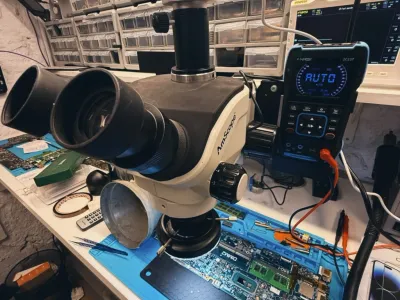
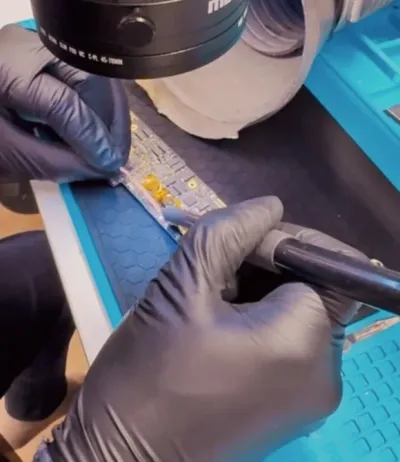
We also work the level above: microsoldering. Microscope, schematics, point-by-point measurement and replacement of the exact component that failed. That’s what makes it possible to recover an iPhone that won’t power on, a MacBook that won’t charge, or the data from a device nobody else wanted to touch. Why we work this way rather than the other is set out on the right to repair.
What we’ve done so far
Since 2015, more than 2,300 Apple devices have come through this workshop, most of them iPhones and Macs. That isn’t a brochure figure: it’s what lets us recognise a symptom the moment it walks through the door, know which fault repeats on which model, and tell you when a device isn’t worth repairing.
It’s also what sits behind our public rating on Google, 4.6 out of 5 across 138 reviews, and behind every repair leaving here with a written 12-month warranty on the part and on the labour.
What component-level repair actually means
This is the part almost nobody explains, so we will. An iPhone or Mac logic board is a circuit with hundreds of components, many of them under a millimetre across, and a fault is almost never “the board”: it’s a power management IC, an open coil, a trace eaten by corrosion, or a pad lifted during someone else’s repair. The work is getting to that exact point.
- Measure before touching anything. Cold current draw, power rails, clock and start-up signals. That’s what turns “it won’t turn on” into a specific, located fault.
- Read the schematics for that model. They tell you what voltage should be at each point. Without them, board repair is guesswork.
- Work under a microscope, with a hot air station, a preheater and a current-limited bench supply — the tool that reveals a short before it can be made worse.
- Replace only what failed, or rebuild lost traces and pads with enamelled copper wire.
- Test the assembled device, not the bare board: the repair isn’t finished until the whole machine works.
Why data recovery and microsoldering go together
On an iPhone, and on an Apple silicon Mac, storage is soldered to the board and encrypted alongside it. You can’t pull the chip and read it elsewhere the way you could with a hard drive: the only route is bringing that board back to a working state. Recovering the data and repairing the board are, technically, the same job.
That’s why we take on cases that get turned away elsewhere, and also why we’re careful with promises: we assess first, then tell you what we expect to recover and what it costs, and we never quote success percentages up front. Your data is handed back on whatever medium you choose and wiped from our machines once the case is closed.
The detail is on data recovery and microsoldering and logic boards.
How we see this work
- Say the price before charging it. The initial diagnosis is free, and if the fault calls for an in-depth one you’ll know before leaving the device with us.
- Tell the truth even when it costs us the job. If repairing it doesn’t add up, we say so with the numbers in front of us.
- Explain what we fit. You’ll know which part is in your device and what warranty it carries, with no small print.
- Respect your data. We access only what the job requires, and nothing leaves the workshop.
- Never promise impossible deadlines. We’d rather give a real timeframe than a flattering one.
- Stand behind the work. Every repair leaves with a written 12-month warranty on the part and on the labour. The conditions are on the warranty page.
Where to find us
At Carrer de Fontanella, 14, ground floor, 08010 Barcelona, a one-minute walk from Plaça Catalunya. The entrance to the workshop is on Carrer de les Moles, 38, right opposite the Leroy Merlin Urban collection point: if you’re circling around Fontanella, turn into Moles.
We serve customers across Barcelona and the metropolitan area, and we also work as a microsoldering lab for other shops and workshops. You can reach us from the contact page.
The company
BestFixing S.L., VAT number B67958017, registered at Carrer de Fontanella, 14, ground floor, 08010 Barcelona. Full legal details are on the legal notice page.
Shall we take a look?
Tell us what’s wrong and we’ll tell you what it is, what it costs and how long it takes. No obligation, and the initial diagnosis is free.
4,6 out of 5 · 138 reviews on GoogleCarrer de Fontanella, 14, bajos · 08010 Barcelona — or drop by Fontanella 14, next to Plaça Catalunya