
Where we stand
The right to repair
This isn’t a label or a campaign. It’s the reason this workshop has a microscope instead of a parts counter: a one-euro component should not condemn an entire board, and with it everything a person had stored on it.
A one-euro component shouldn’t cost you a whole board
When a coil goes open or a power management IC dies, the service manual from almost any manufacturer says the same thing: replace the board. That means throwing away a ten-layer circuit with hundreds of healthy components because one of them failed. On an iPhone, or on an Apple silicon Mac, it also means throwing away the storage, which is soldered to that same board and encrypted against it.
The device can be replaced; ten years of photographs cannot. That’s also why data recovery and board repair are one and the same job here: with soldered storage, the only route to the files is bringing that board back to a working state. The detail is on data recovery.
We work the level below: find the specific component that failed and replace it. It is slower, it needs a microscope, schematics and point-by-point measurement, and it doesn’t always work out. But when it does, the device is still the same device with its data inside, and no new board had to be manufactured. That is what the right to repair means once it comes down from politics to the workbench: that someone knows how to look inside, and has the means to do it.
What repairing a board takes, as opposed to swapping it
The gap between replacing a module and repairing a board isn’t one of degree — it’s a different trade. Here is what the second one asks for, and why so few places do it.
- Measure before touching anything. Cold current draw, power rails and start-up signals. That’s what turns “it won’t turn on” into a specific point on the circuit.
- The schematics for that model. They say what voltage should be at each point. Without them, board repair is guesswork — and no phone manufacturer publishes them.
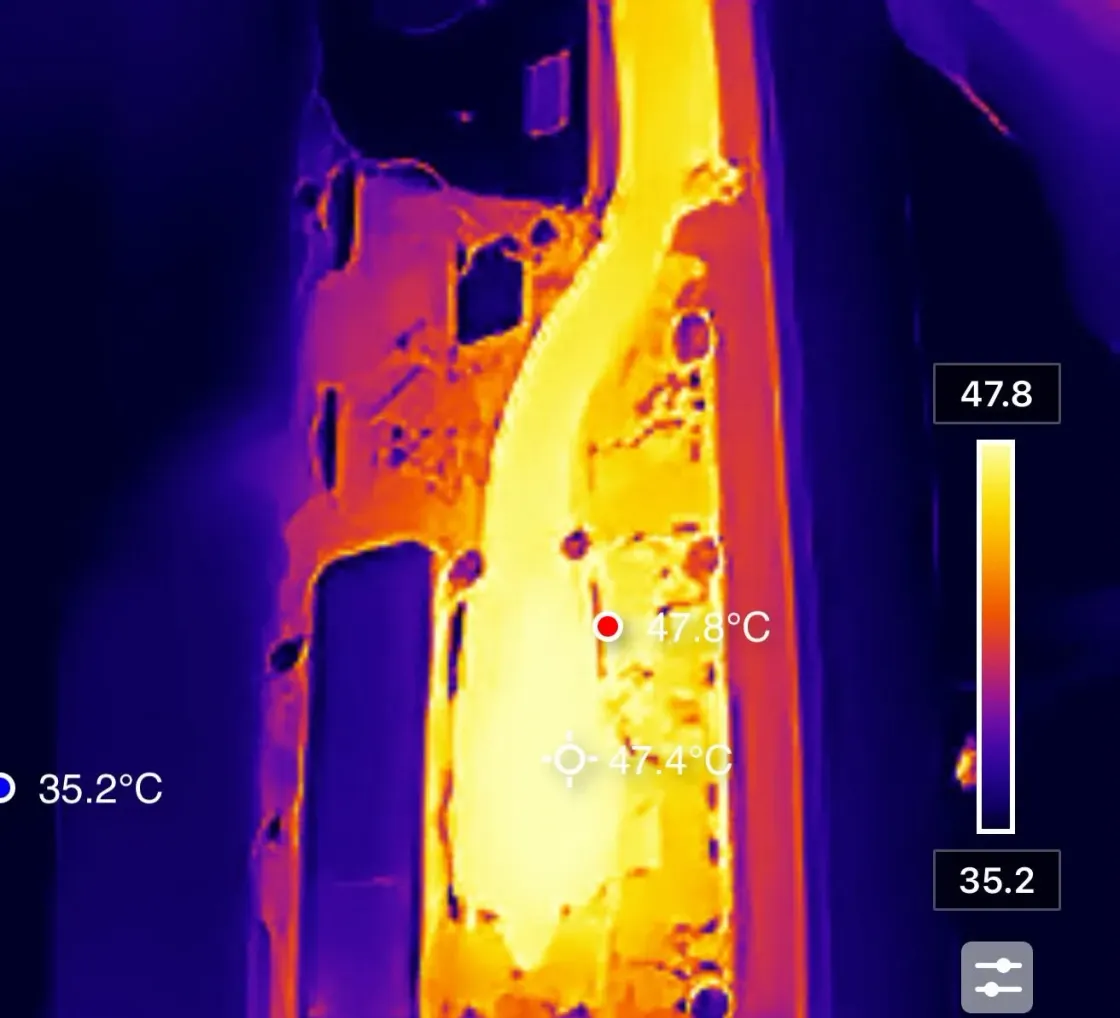
- A thermal camera and a current-limited bench supply. This is how a short is located without making it worse: feed the board with the current capped, and the component that heats up before the others is the one pulling the rail down.
- Individual components. From electronics distributors or harvested from donor boards, because there is no other source: no official catalogue of phone ICs exists.
- Knowing how to rebuild what’s gone. Traces eaten by corrosion and pads lifted during someone else’s repair get remade with enamelled copper wire. The full process is on microsoldering and logic boards.
What our own job sheets say
The proof that this isn’t just talk is the paperwork. Between 2021 and 2026 the workshop’s intake book ran to 860 job sheets, and that record says three things worth reading together.
All three come from the intake book rather than from an estimate, which is why they always carry their period and their sample size. No shop that only swaps modules can quote them: without board-level repair, an unsolved “it won’t turn on” isn’t one sheet in eight hundred — it’s the default answer.
- Seven devices beyond repair, in total. Under one per cent. Everything else left here with a diagnosis and a route forward, even when the route forward was “this isn’t worth fixing”.
- 87.9% handed back. That’s the share of job sheets that end with the device back in its owner’s hands.
- 52.4% weren’t Apple. Lenovo, HP, Asus, Dell, Acer and Samsung lead the rest. Microsoldering doesn’t care about logos: a dead power rail is hunted down the same way on a MacBook board as on a work laptop, which is what PC and Android repair is about.
Why we’re not in Apple’s Independent Repair Provider programme
We looked at it seriously and read the contract before deciding. The answer was no, and it deserves an explanation, because this isn’t abstract principle: the programme and this workshop simply don’t fit in the same room.
The agreement made public in 2020 requires the shop to accept unannounced inspections looking for “prohibited parts”, with a penalty of a thousand dollars per transaction if more than two per cent of them involve any; to hand Apple the names, addresses and phone numbers of its customers; and to keep those records, subject to inspection, for up to five years after leaving the programme. There is no evidence those terms have since been softened.
The first point is the one that makes it unworkable. Component-level repair runs on ICs from distributors and on parts harvested from donor boards, because no phone manufacturer sells individual integrated circuits. Signing that contract would be undertaking to stop doing the exact thing this workshop exists to do.
- This is not a criticism of genuine parts. When a job calls for a module and a genuine one is available, a genuine one goes in.
- It is a criticism of the model. A programme that audits which components you may use decides in advance how far you are allowed to repair.
- And it has a physical consequence. Every board replaced that could have been repaired is electronic waste that didn’t need to exist, and one more device out of circulation.
Self-repair programmes are progress, but they stop short of the board
It’s worth acknowledging what has changed, because the argument of a few years ago no longer holds: since 2022 Apple has sold genuine parts and manuals to any individual, and parts pairing has been loosening under the pressure of US state laws. That is better than what came before.
But look at the catalogue before calling it solved. What is sold are assemblies: displays, batteries, cameras, speakers. On the MacBook Pro the battery isn’t even sold on its own — it comes inside the full top case with the keyboard. What that list doesn’t contain is a single integrated circuit — not the charging controller, not the power IC soldered to the board — nor the schematic that says what voltage should be at each point.
That line, assembly versus component, is where the programme ends and this work begins. And it isn’t a technical nicety: it decides whether a laptop that stopped charging is fixed for the price of a chip or for the price of a whole board.
What European law says, and what it doesn’t
In 2024 the European Union adopted Directive (EU) 2024/1799 of 13 June 2024 on common rules promoting the repair of goods. Member States had until 31 July 2026 to bring it into national law — that deadline has now passed, so this has stopped being a promise about the future.
It moves the line, and in the right direction. These are the three parts that matter most to someone holding a broken device:
- It obliges the manufacturer to repair. At the consumer’s request and outside the guarantee period too, for the products listed in Annex II of the directive, free of charge or at a reasonable price.
- It creates a European online repair platform so people can find a repairer nearby. The directive sets the common interface to be operational by 31 July 2027 at the latest.
- It doesn’t change the heart of this trade. No rule today requires anyone to sell a power management IC on its own. While that holds, whether a board gets repaired will keep depending on there being workshops that know how and suppliers that stock the component.
What you can ask of us
Brought down to what actually happens when you walk through the door, the right to repair is this:
- That we tell you what failed, not “the board”. If the diagnosis is a specific component, you’ll get its name.
- That repair is attempted before replacement whenever it makes technical sense. And that when it doesn’t add up, we say so with the numbers in front of us, even if it costs us the job.
- That your data stays yours. We access only what the repair requires, and it’s wiped from our machines once the case is closed.
- That you know which part is in your device, where it came from and what warranty it carries. The terms are on the warranty page, and the full route a repair takes is on how it works.
Frequently asked questions
Is repairing the board as reliable as replacing it?
On a localised fault, yes: the component that failed is replaced and the rest of the circuit is still the factory original. What wouldn’t be honest is promising it up front. There are boards with corrosion spread across them, or with a badly resolved earlier repair, where we say no — and those are the ones that make up the seven that didn’t make it.
Do you use genuine parts?
When a job calls for a module and a genuine one is available, a genuine one goes in. At component level that option doesn’t exist, because no phone manufacturer sells integrated circuits: the work is done with parts from electronics distributors and components harvested from donor boards, which is how electronics repair works in every sector. You will always know what is in your device.
What happens to my data if the board won’t boot?
On an iPhone, and on an Apple silicon Mac, storage is soldered to the board and encrypted against it, so it can’t be pulled out and read elsewhere. Getting to the files means bringing that board back to a working state, which is the same microsoldering job. That’s why we take on cases other places turn away on sight.
Does this only apply to Apple hardware?
No. Slightly more than half of what came through the workshop between 2021 and 2026 wasn’t Apple. A Lenovo, HP, Asus or Dell laptop that won’t turn on is diagnosed with the same microscope, the same instruments and the same method.
When do you say a repair isn’t worth it?
When the cost of the work approaches what the device is worth, when the damage is spread across the whole board, or when an earlier repair has left the circuit in a state we couldn’t stand behind. We say so before starting and with the quote in front of us, even when it means losing the job.
Shall we take a look?
Tell us what’s wrong and we’ll tell you what it is, what it costs and how long it takes. No obligation, and the initial diagnosis is free.
4,6 out of 5 · 138 reviews on GoogleCarrer de Fontanella, 14, bajos · 08010 Barcelona — or drop by Fontanella 14, next to Plaça Catalunya